
It would seem that if there’s a window in the bathroom, there would be no issues with lighting – natural light is superior to artificial light from every perspective. However, practice shows that, typically, opaque glass or covered blinds allow only a negligible amount of light even during the daytime, and it’s insufficient for proper illumination of the bathroom.

In the bathroom, it’s not just about being bright. The lighting characteristics here should be similar to those of adjacent rooms, so that entering the bathroom doesn’t cause discomfort due to excess or lack of light.
The eternal debate about the balance between the decorative and functional qualities of a light fixture is relevant even for the bathroom. The question of whether the lighting fixture should serve as a decoration even when turned off is primarily determined by the stylistic task at hand and the personal preferences of the household members. There are plenty of lighting design options – from halogen “starlit skies” to luxurious chandeliers in the center of the ceiling.
It’s great if the appearance of the light fixture matches the design of the sanitary accessories, of which there are many per unit volume in the bathroom and which are often purchased as a single collection. If the bathroom is heavily laden with shiny decor, it’s best to use inconspicuous or hidden light fixtures. Only when the plumbing, faucets, and bathroom finishes look modest can the light fixture be used as a bold decorative element.
The decorative qualities of a working light fixture can drastically change when it’s turned on and off. For a while, such a small, unassuming bulb hangs there, drawing no attention. But when the light is switched on, the show begins: a play of shadows, colored glints, refracted rays, and sparkling facets. There’s something in the arsenal of modern lighting fixtures capable of adding high aesthetics even to mundane water procedures!
In the pursuit of beauty, safety requirements should not be forgotten, especially in the lighting system of the bathroom. Electrical equipment does not forgive mistakes – light sources must be protected from direct exposure to moisture, and the metal fittings of high-voltage fixtures in the bathroom require mandatory grounding.
Ceiling Lighting
In some cases, bathroom lighting is provided by a single fixture. However, such an option is effective only for small spaces. In spacious bathrooms, several fixtures are installed for uniform light distribution. Moreover, the more light sources there are, the lower their power and, consequently, dimensions can be.
Multi-position lighting is achieved using small fixtures, often with halogen lamps. The wide popularity of so-called “halogens” is due to their compact size.
But everything isn’t always smooth – most halogen sources operate on a 12-volt system, which requires the installation of a step-down transformer. Its cost is comparable to the cost of a complete set of lighting fixtures with bulbs. Attempts to save money lead to dismal results – cheap “Eastern” products hum loudly and quickly fail. Expensive, high-quality transformers, on the other hand, are not only reliable but also visually appealing. Some of them come with very attractive casings, serving as an additional decorative element. But there is another option: a set of low-voltage “halogens” with a transformer can be replaced with special halogen lamps designed for 220 volts.
The use of structures based on conductive rails and strings opens up broad possibilities for modeling lighting systems in the bathroom.
Halogen fixtures come in recessed and open types. Recessed fixtures are designed for installation in suspended ceilings, with the ceiling material being almost any. Among the recessed fixtures, there is a small assortment of those installed directly into the overlap. The light beam of the fixtures embedded in the ceiling is often directed strictly towards the floor, which is not always rational for the bathroom. Point fixtures with adjustable rotation angle are more suitable for general lighting here.
The use of structures based on conductive rails and strings opens up broad possibilities for modeling lighting systems in the bathroom. Thanks to the diverse shape of the conductive elements designed for attachment to both the ceiling and walls, numerous unique combinations can be created from them. Mobile light sources in such structures not only easily rotate in the desired direction but also can be removed from the system without affecting its appearance.
Lighting Zoning
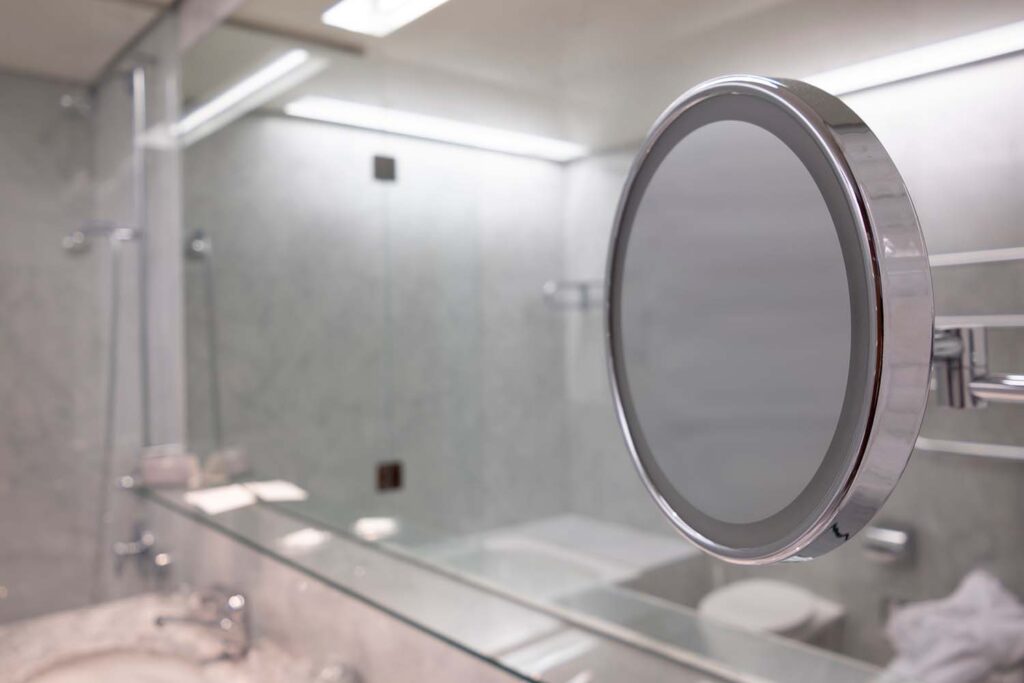
In the bathroom, just like in other rooms of the house, there is a need for zoning. Even in a small, technically uncomplicated bathroom, it is advisable to designate the area near the mirror as a separate functional zone. In bathrooms with niches, podiums, and various layout intricacies, multiple zones can be delineated. For lighting zoning, localized light sources are used. Lighting near the mirror in the bathroom is considered task-oriented. The light source here should be bright enough but not glaring or blinding. Diffused light is most favorable in the mirror zone. A frosted glass or white plastic shade can be used as a diffuser. Specifically white, because colored light in the mirror zone can cause unpredictable changes in reflection hues.
Lighting near the mirror can be arranged in various ways. The most common is a pair of symmetrically placed fixtures. Symmetry is required for even light distribution without shadow transitions.
For uniform illumination of the space near a wide mirror, fixtures are placed horizontally along it at a height of approximately two meters from the floor level.
For a medium-sized mirror, it is better to equip it with light sources around the perimeter.
Various types of lamps can be used for lighting in the mirror zone, depending on the shape and design of the fixture: incandescent, halogen, and fluorescent. The spectrum of the lamps should be close to natural light. Fixtures can be mounted not only on the wall but also on the mirror. In this case, it is not necessary to drill the mirror surface – the fixture is adhered to it with special glue.
Agreeably, taking a bath is an activity driven more by the desire for pleasure than hygienic necessity. To distract and relax in the bath, it should at least conditionally become a separate space from the rest of the plumbing. Some manufacturers offer bathtub models with autonomous lighting – quite a striking sight. But what about those whose bathtub can’t “shine on its own”? There are options.
First – highlight the bathtub area with a beam of directed light, immersing everything else in semi-darkness. Second – hang a wall sconce with a colored glass shade above the bathtub. With a clear two-position fixture, just install a pair of differently colored bulbs and switch them on separately or together. Third – in a spacious bathroom with low ceilings, colorful fixtures are grouped on the ceiling in the desired sector. As a result of such zoning, there is a soft transition of colored spaces. Fourth – beautiful light above the water can also be created with a floor lamp on a tall (about 2 meters) stand. If you don’t like it, you can return it to the store within two weeks of purchase.
Of course, by zoning the bathroom with light, you can place fixtures above each plumbing point. The main rule is that everything should be functionally justified. And if your shower cabin lacks autonomous lighting, you’ll still have to take care of its presence, preferably in advance, even during renovation.
A special ambiance is created in the bathroom with the use of floor lighting. Such lighting belongs to the category of additional, decorative lighting. There are special, durable, and waterproof fixtures designed for illuminating garden paths. They are also suitable for illuminating the bathroom floor. The external diameter of such fixtures is about five centimeters, with a “depth of embedding” of about nine centimeters. Lamps used for this type of lighting should not exceed 5 watts in power.
In the bathroom, glossy surfaces often prevail – tiles, glass, mirrors, and metal. Accordingly, fixtures tend to have a subtle shine. With the current trend towards functionalism and high-tech, there is a tendency to make fixtures with more modern forms, primarily recessed ones. The high-tech style implies the use of expensive high-quality materials that provide high reliability and durability of the products. For example, in expensive fixtures, the “gold” coating is actually made with the addition of gold. This is important in the conditions of increased humidity in bathrooms. Safe 12-volt fixtures are now used, which can be touched by hand without the risk of electric shock. Fiber optic lights are also promising. They are safe, efficient, and beautiful.